
Building the future
of civil society


 Steph Kersten-Johnston, Peter Halliwell & Laura Picot · Amsterdam · Founded 2026
Learn more ↓
Steph Kersten-Johnston, Peter Halliwell & Laura Picot · Amsterdam · Founded 2026
Learn more ↓
Our mission
We work towards a world where civil society is a strong counterweight,
holding power to account for people, other species and the planet.
But the odds are stacked against advocates for the common good, and AI is concentrating power further.
UpSide mobilises movements and builds shared tools to tackle this.
Strategy
Spotting where and when to act.
Coordination
Agreeing priorities across differences.
Representation
Bringing in voices rarely heard.
Building for the challenges of today
The challenges
Outmatched on lobbying
EU corporate lobby spending has grown 50% since 2020, and NGOs can’t match it.1 Policy risks being captured by narrow interests.2
Information overload
The EU passed 2,570+ legal acts in 2025 alone.3 Advocates are overwhelmed,4 and key windows for action slip past.
Fragmented into silos
Civil society is split into single-issue silos,5 and natural allies rarely sustain working together beyond a single campaign grant.
Our solutions
The UpSide platform gives a live picture of EU decision-making and a private space for your coalition to act on it.
See the full picture
- Every relevant file, stage by stage, and who decides next
- Amendment tracking with each organisation’s position
- Policymaker stances with votes, speeches and declared lobby meetings
- Public narratives with daily media summaries
Work together
- Plan: a private space where your coalition works around policy files
- Act: shared actions with owners and deadlines
- Stay in sync: a joint calendar, shared feed and files board
- Every claim links to a verifiable primary source
- Private by default: you decide what’s shared
- Built alongside the coalitions who use it
See it in action
A walk-through of our coalition space
“This would be gold. I’d spread this to everyone.”
Amendment tracker feature zoom-in
This platform feature maps organisational positions against proposed legislative amendments, and flags where coalition partners agree and disagree. Shown here for the EU Safe Hearts Plan.
“Normally I’d spend days searching through these amendments; now it’s all analysed and presented in a much easier-to-understand format.”
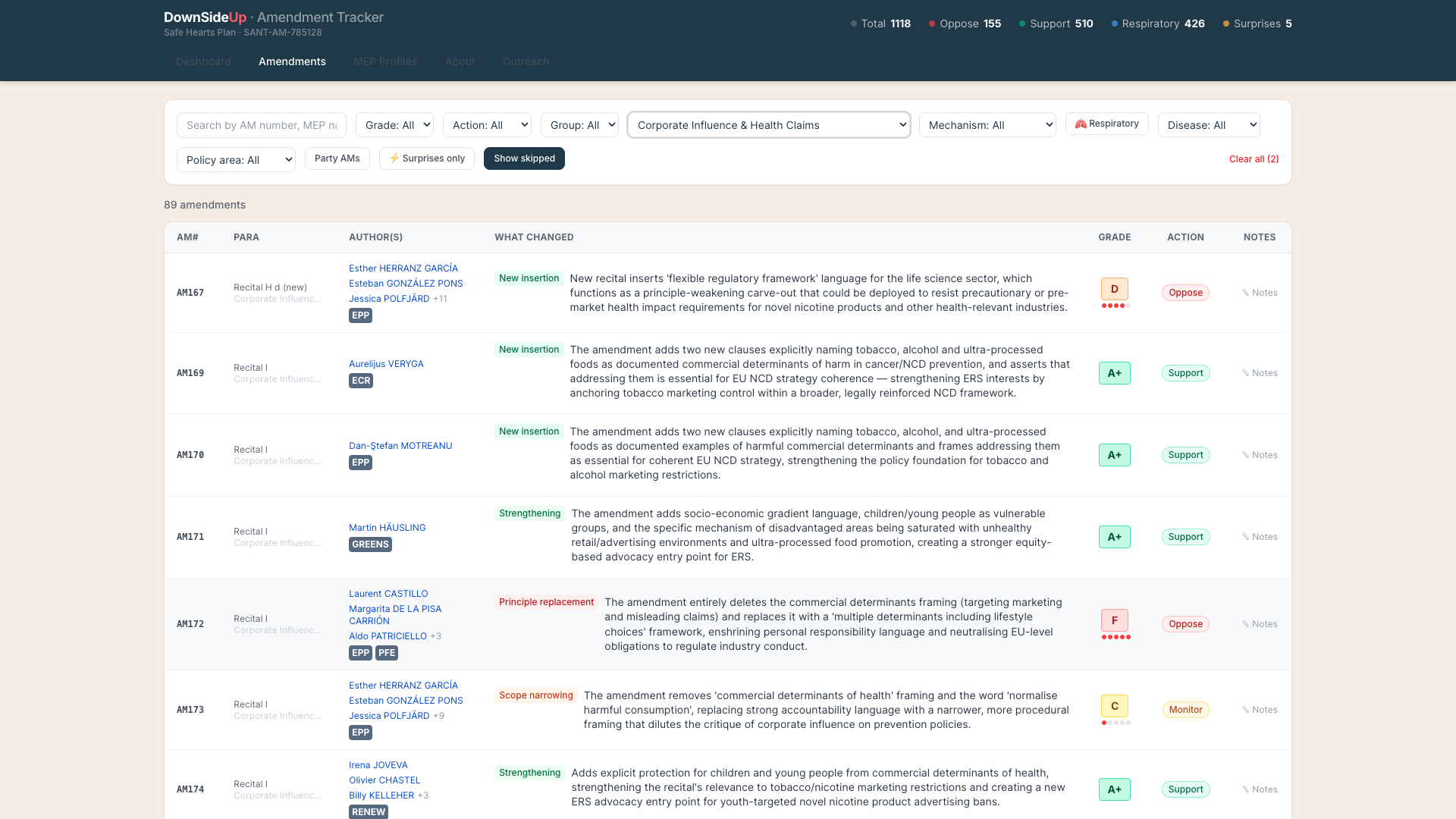
Our platform is already used by EU advocates working on food systems, public health and AI policy.
Interested in your coalition joining?
Preparing for the challenges of tomorrow
AI is concentrating power
AI is being built and controlled by a handful of companies and governments, giving them growing influence over wealth, information and politics.6,7
How can civil society keep power in check for the common good?
Our solutions
Foresight research
On how civil society must adapt and what we build next.
Platform for AI resilience
Growing our AI policy coalition (watch this space…)
“What UpSide is building sounds amazing, something everybody would be hoping for if they knew it was already in the making.”
The team
We founded UpSide to build the shared infrastructure we missed while working from within civil society.
Stephanie Kersten-Johnston
Co-founder · Strategy & Operations
Leads strategy, pilot partnerships and operations. Steph spent 20 years building and scaling sustainability, circular-economy and food-systems programmes inside global corporations and NGOs, in the US and Europe. Most recently she worked on alternative protein advocacy at the Good Food Institute Europe. She turns strategy and funding into operating capacity. Based in Amsterdam.
Peter Halliwell
Co-founder · Product & Comms
Leads UpSide’s technical architecture, product and intelligence system. Peter helped develop methods and products at Silicon Valley startups before moving into policy, and personally built UpSide’s first policy intelligence tools, now in use with pilot partners, during his role at the European Respiratory Society. 14 years across digital product, management consulting and corporate communications. Based in Hamburg.
Laura Picot, PhD
Co-founder · Research & Engagement
Leads UpSide’s funder and network relationships, foresight research, and strategic thinking on how AI reshapes civil society. Laura spent 10 years tackling climate change, including an Oxford PhD in climate adaptation and specialist roles at the FAO, Systemiq and the European Policy Centre in Brussels. She sits on the advisory board of TABLE, an impartial food-systems platform. Based in Amsterdam.

Philippa Griffin
Fellow · Coalition Strategy
Leads UpSide’s work with pilot coalitions and new user groups. Philippa has spent 15 years advising governments, foundations and global companies on sustainability and economic strategy at Vivid Economics, Mott MacDonald, FTI Consulting and McKinsey, where most recently she worked on climate finance, impact investment and decarbonisation. Based in Dublin.
Get involved
Coalitions and movements
Want to use the platform? Bring your live advocacy work, and shape what we build next.
Use the platform →Funders
We’re raising to grow the platform across movements and develop further tools. Our funding memo is available on request.
Talk funding →Thinkers and collaborators
Working on foresight, civic tech or democratic infrastructure? Let’s explore ideas and build together.
Partner with us →Or email us directly: info [at] up-side.org
Not ready to talk yet? Follow our progress. We share occasional updates on what we are building and learning, when there is something worth sharing.
Follow us on LinkedInSources
1. Corporate Europe Observatory, 2026: The EU corporate lobby league 2026; 2022: Who spends most?
2. OECD, 2021: Lobbying in the 21st Century
3. European Commission, 2025: EUR-Lex statistics
4. UpSide, 2026: semi-structured interviews and a focus group with 30+ NGO advocates (summary of findings available on request)
5. National Committee for Responsive Philanthropy, 2013: Smashing silos in philanthropy
6. AI Now Institute, 2025: Artificial Power: 2025 Landscape Report
7. Forethought, 2025: AI-Enabled Coups: How a Small Group Could Use AI to Seize Power